The Assumption Hidden Inside Global Best Practice
The operational processes developed in the world\’s largest economies were designed to solve the realities of those economies. Whether we are discussing logistics, manufacturing, banking, or supply chain management, most internationally recognised operating models share a common assumption: that the environment in which they operate is reasonably predictable. Infrastructure is expected to function consistently, regulations are interpreted uniformly, and administrative procedures change slowly enough for organisations to build stable systems around them.
Mozambique operates under a different set of realities.
This does not mean our market is inefficient and it does not suggest that international best practice has no place here. It simply means that processes designed elsewhere do not always react in the same way once they reach Mozambican territory. The environment introduces variables that many global systems were never built to anticipate, and it is precisely within those variables that organisations begin to lose operational efficiency.
So, the challenge is rarely that the process itself is wrong. More often, it is that the process assumes a level of consistency that the local operating environment cannot always provide.
When the Dashboard Stops Reflecting Reality
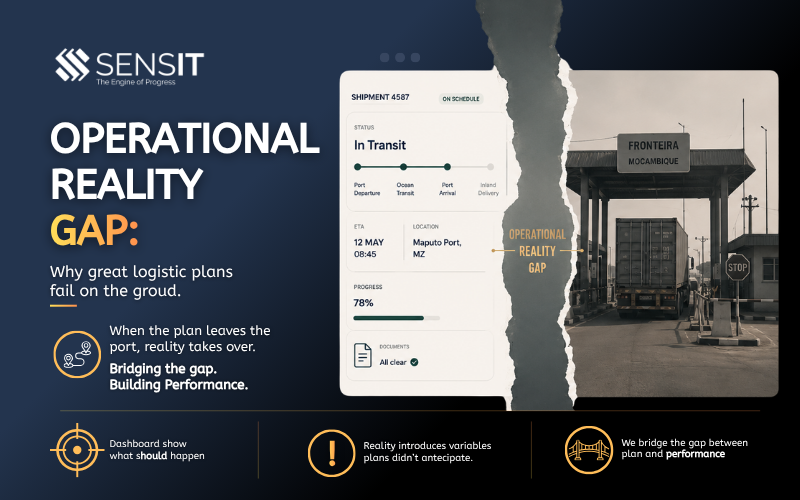
Imagine a container ship crossing thousands of kilometers of ocean ahead of schedule. It arrives at the port exactly when expected, the cranes unload every container with precision, customs documentation appears complete, and the logistics dashboard fills with reassuring green indicators. From the perspective of the organization\’s headquarters, everything is unfolding exactly as planned.
Then the container leaves the port. A border authority requests documentation in a format that was accepted differently only days before. A shipment that appears routine suddenly falls under an unexpected interpretation of local regulation. A vehicle export follows standard cargo procedures only to discover, once it reaches the frontier, that vehicles are processed according to an entirely different administrative pathway.
Meanwhile, the dashboard continues reporting that the shipment is \”In Transit\”.
Reality tells a different story. The cargo is no longer moving. It is waiting.
The organization has not lost visibility because the software failed. It has lost visibility because the system continues describing the world as it was designed to behave, rather than the world as it actually behaves.
We have started referring to this disconnect as the Operational Reality Gap: the distance between what corporate systems believe is happening and what is actually happening on the ground. It is within this gap that organizations quietly begin losing time, customer confidence, and profitability.
Why Local Friction Is Different
One of the assumptions hidden inside many internationally recognized operational models is consistency. They assume consistent infrastructure, consistent administrative procedures, predictable regulatory interpretation, and institutions operating with similar rhythms and priorities.
Operational excellence in Mozambique often depends on something different. It depends on adaptability.
The organizations that consistently perform well are rarely those with the longest operating manuals or the most sophisticated technology. They are the organizations that recognize when reality has shifted and adjust before that shift compounds into delays across the rest of the operation.
This is why importing a process that performs exceptionally well somewhere else does not automatically produce the same results here. The process itself may be excellent. It was simply designed for a different operating environment.
The Numbers Tell the Same Story
The Operational Reality Gap is not simply a local observation. It reflects a challenge that has been documented across emerging logistics corridors around the world.
International research consistently shows that the greatest operational losses rarely occur during ocean transit or long-haul transportation. They occur much later, when carefully designed plans encounter the realities of local infrastructure, administrative interpretation, and border operations.
According to the World Bank\’s Logistics Performance Index (LPI), reliability in developing trade corridors is often compromised during the transition between ports and inland destinations. Administrative friction, documentation requirements, and localized operational variability can account for up to 40% of total transport costs in emerging markets. In other words, the most expensive part of the journey is often not moving the cargo across continents, it is moving it through the final kilometres of execution.
Regional research tells a remarkably similar story. Studies examining trade routes across the Southern African Development Community (SADC) describe what researchers call \”Unproductive Dead Time\”: the hours or even days that vehicles remain stationary while waiting for inspections, approvals, documentation, or coordination between institutions. These seemingly small delays can reduce fleet utilization by nearly half, directly affecting freight competitiveness, customer commitments, and overall operational profitability.
This is why organizations frequently underestimate the real cost of operational friction.
The expense is rarely a single delayed shipment.
It is the accumulation of hundreds of small delays that quietly consume capacity, increase costs, and reduce an organization\’s ability to execute consistently.
When Procedures End, Experience Begins
During one of our research interviews with a professional from Mozambique\’s logistics sector, he summarised the challenge in a sentence that has stayed with us ever since.
\”What\’s written and what actually happens are two different things… in the office we always think things could have been better.\”
That observation extends far beyond logistics.
Across our conversations with professionals in logistics, industrial operations, banking, and infrastructure, we continue to notice the same pattern. Organisations rarely struggle because they lack procedures. Most have procedures, manuals, dashboards, and reporting systems. The real challenge begins when those procedures stop reflecting the reality that employees face every day.
This is where experience quietly takes over.
The dispatcher who already knows which authority to contact before a shipment becomes delayed. The operations coordinator who immediately recognises which document is likely to create resistance. The driver who adjusts a route because years of experience have taught him something that no dashboard can detect.
These individuals are often described as experienced employees. We believe they are something much more valuable.
Why Some Organizations Still Deliver
If these operational realities affect everyone, why do some organizations consistently outperform others?
It is tempting to credit better software, more detailed procedures, or larger operational budgets.
In our experience, that is rarely the deciding factor.
More often, the difference lies in the people who have spent years learning how to navigate realities that no manual anticipated. Long before a dashboard detects a problem, they have already adjusted. Long before a shipment becomes delayed, they have already made the phone call, prepared the additional documentation, or anticipated the administrative obstacle ahead.
The system appears resilient.
In reality, experienced people are quietly holding it together.
The Hidden Genius Already Inside Your Organisation
Over time, these people develop an instinct for recognizing patterns that have never been documented. They know which conversations need to happen before problems appear, which documents require additional attention, and which decisions genuinely require escalation. What appears to be intuition is, in reality, deeply refined operational knowledge.
The difficulty is that this intelligence usually exists only inside their heads.
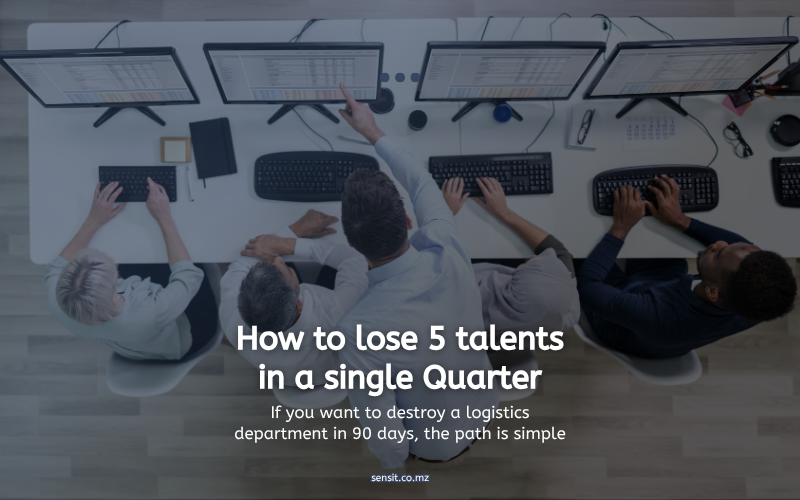
When an experienced dispatcher, supervisor, or operations coordinator leaves the organization, they take with them years of accumulated judgement that was never transferred into the organization itself. The company does not simply lose an employee. It loses a way of solving problems.
From Individual Expertise to Organisational Capability
Traditional consulting often responds to these challenges by introducing external methodologies and asking organizations to adapt to them.
Our approach begins somewhere else.
Rather than importing excellence, we identify where excellence already exists. We observe the individuals who consistently produce reliable outcomes despite operational complexity, isolate the decisions they make almost instinctively, and transform those behaviours into systems that can be learned, replicated, and continuously improved.
The objective is not simply to improve today\’s operation. It is to ensure that the organization retains its most valuable operational intelligence long after individual employees have moved on.
That is how institutional capability is built.
Not by replacing local knowledge, but by recognizing it, preserving it, and transforming it into part of the organization\’s operating system.
The Competitive Advantage Nobody Sees
Technology will continue to improve. Logistics platforms will become faster, dashboards more intelligent, and artificial intelligence more capable of predicting operational risk.
Yet one reality is unlikely to change.
The organizations that outperform the rest in Mozambique will not necessarily be those with the most advanced technology. They will be the organizations that understand their own operating environment better than anyone else and systematically capture the knowledge of the people who have already learned how to navigate it.
Because competitive advantage does not disappear when a truck stops moving.
It disappears when the knowledge required to move it again exists only inside one person\’s head.
If this reflects challenges your organization is currently facing, we\’d be glad to explore them with you.
Schedule an Executive Sync with SENSIT to discuss how operational knowledge can be transformed into scalable systems that strengthen execution across your organization.